
Answers with reasons
Decide access from the membership option, exact membership period, dates, organization settings, and authorized exceptions, with the reason available for support.
Member access
Recalculate access to publication archives, forums, resource centers, directories, and other configured services from the member’s exact membership period and organization policy. Carry that decision into the systems your organization already uses through bespoke integrations, scoped APIs, and signed webhooks.
Preparing for a limited pilot. Production use follows an organization-specific migration, rehearsal, configuration, and approval.
The governing idea
MembershipPortal evaluates the membership option, exact membership period, effective dates, organization policy, and approved exceptions before it sends an update. Each destination receives only the member state or event it needs, while failed delivery stays visible for review, retry, and reconciliation.
Northstar in practice
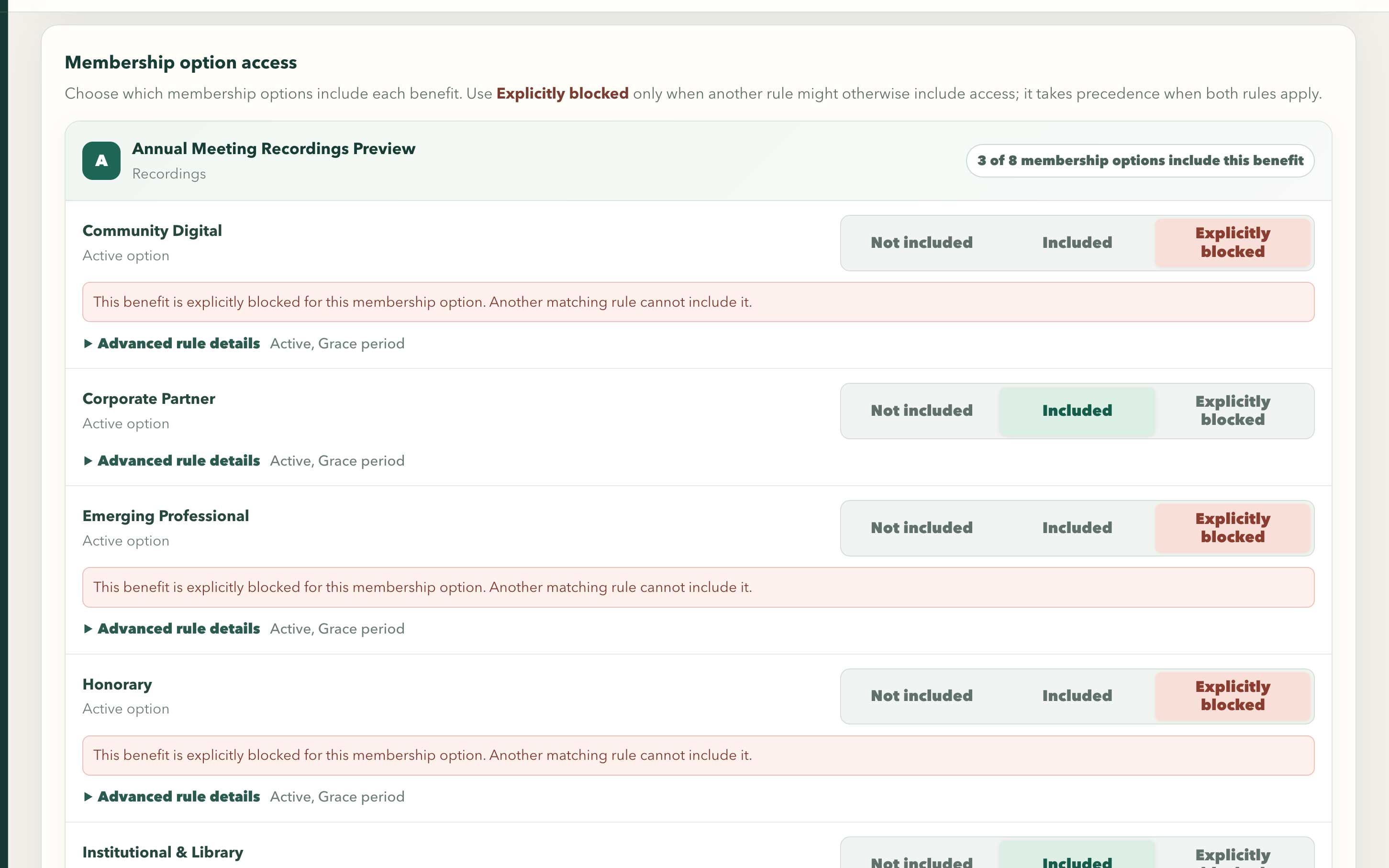
Membership-option rows make included, not included, and explicitly blocked access choices visible before saving.
Swipe or use arrow keys to inspect the full viewDecisions people can understand
01Staff can answer why access was granted or denied without reverse-engineering a connected service.
Decide access from the membership option, exact membership period, dates, organization settings, and authorized exceptions, with the reason available for support.
Use the same membership truth for publication archives, current issues, forums, resource centers, directories, and other configured resources.
Allow a narrowly authorized override with explicit precedence, dates, reason, and audit context instead of a hidden destination-side change.
A connected member experience
02Members enter through the mobile app or responsive portal with a stable identity while each connected service keeps responsibility for its own experience.
Use Discourse sign-on with a stable external ID and verified email, then align protected groups with the current membership decision.
Issue short-lived signed access tokens and share only the scoped member state required by the configured resource-center connection.
Remove protected groups according to lapse and grace policy while preserving permitted public forum access and the forum user’s history.
Failures that do not disappear
03A destination problem should be visible to staff without undoing the membership decision that caused the change.
Show destination health and payload-redacted failure records with response status, timing, and the authorized next action.
Compare expected access with the destination, retry failed delivery without duplicating the source change, and preserve the recovery history.
Keep each attempt, redacted outcome, authorized replay, and final reconciliation attached to the destination and source change that produced it.
Built around your stack
04Journal hosts, communities, learning platforms, resource libraries, directories, and internal tools all have different interfaces. MembershipPortal supports a deliberately scoped integration plan for each destination.
Plan a connection around the destination’s actual identifiers, groups, roles, and interface. Bespoke work is scoped and reviewed during implementation, using the narrowest suitable pattern instead of promising a one-click catalog.
Let approved server-side systems request only the membership and entitlement data they need through versioned, organization-scoped endpoints. Credentials stay out of browsers, and access is limited to the required operations.
Send membership and access events to a wide variety of destinations with signed payloads, stable event identifiers, retries, and delivery history so receiving systems can process each change safely.
Direct answers
Each answer links to the practical product guidance behind it.
No. Existing forums, resource centers, and specialist services can remain responsible for their own experiences. MembershipPortal provides the verified membership and access decision those services need. Read about connected services
Yes. Access decisions use the membership option, exact membership period, dates, organization settings, and approved exceptions, with the reason available for authorized support work. See how access is explained
The membership decision remains intact while delivery failures stay visible for authorized review, safe retry, and reconciliation. Recovery history remains connected to the source change. Read about integration recovery